
HIPAA Compliant Transcription Workflows That Protect Patient Data
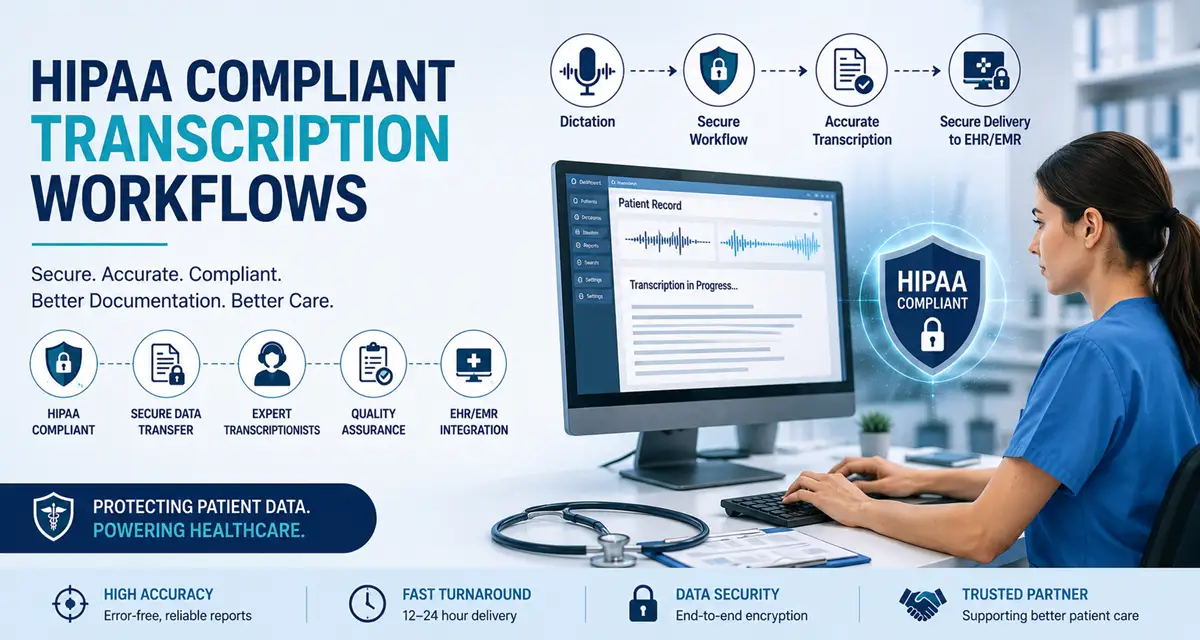
Healthcare organizations in the United States handle thousands of patient records every day. Every report must be accurate, secure, and completed on time. This is why HIPAA Compliant Transcription Services remain an essential part of modern healthcare documentation. A well designed transcription workflow helps hospitals, clinics, physician practices, and healthcare organizations protect sensitive information while improving productivity and patient care.
According to the U.S. Department of Health and Human Services, HIPAA establishes national standards to safeguard protected health information. Healthcare providers must ensure that every stage of documentation follows these privacy and security requirements.
Why HIPAA Compliance Matters in Medical Transcription
Medical reports contain confidential patient information such as diagnoses, medications, treatment plans, and laboratory results. If this information is exposed, healthcare providers may face financial penalties, legal action, and loss of patient trust.
A secure transcription workflow helps organizations:
- Protect patient privacy
- Reduce the risk of data breaches
- Meet HIPAA requirements
- Improve documentation quality
- Support better patient care
HIPAA compliant workflows also include secure file transfer, encrypted storage, controlled user access, regular audits, and confidentiality agreements for transcription professionals.
Key Elements of a Secure Transcription Workflow
An effective workflow is built around security and quality.
Secure Dictation
Physicians record patient notes using secure digital platforms or encrypted mobile applications instead of unsecured devices.
Encrypted File Transfer
Audio files are transmitted through secure channels using encryption to prevent unauthorized access during transfer.
Skilled Medical Transcriptionists
Experienced transcriptionists understand medical terminology, specialty specific language, and HIPAA regulations. Every report is prepared with close attention to detail.
Quality Assurance
Reports are reviewed through multiple quality checks before delivery. This process helps maintain consistency and reduces documentation errors.
Secure Delivery
Completed reports are delivered through secure portals or integrated directly into the healthcare provider’s electronic medical record system.
Traditional Medical Transcription vs AI Transcription
Artificial intelligence has introduced faster speech recognition tools. However, AI alone still struggles with complex medical language, multiple speakers, accents, background noise, and specialty terminology. Human transcription remains the preferred choice for critical medical documentation.
| Factor | Traditional Medical Transcription | AI Transcription |
|---|---|---|
| Cost | Predictable pricing with fewer correction costs. | Lower initial cost but editing often increases expenses. |
| Accuracy | Excellent accuracy through human review. | Accuracy may decline with complex medical dictation. |
| Speed | Fast turnaround with quality assurance. | Creates instant drafts but requires manual verification. |
| Ongoing Effort | Minimal physician involvement after dictation. | Staff spend additional time reviewing and correcting reports. |
| Integration | Works seamlessly with EMR and EHR systems. | Integration depends on the software provider. |
| Compliance | Strong focus on HIPAA compliance and confidentiality. | Requires additional oversight and security validation. |
Accuracy Makes a Difference
Medical documentation directly affects patient safety.
Research published by the National Library of Medicine has shown that documentation errors can contribute to medical mistakes and communication failures. Even a small transcription error involving medication dosage, diagnosis, or procedure can have serious consequences.
Professional transcriptionists review reports carefully, identify unclear dictation, and apply medical knowledge to produce accurate clinical records.
Cost Should Include Quality
Many healthcare organizations focus only on the initial price of transcription. However, correcting inaccurate reports consumes physician time and increases administrative costs.
Choosing an experienced transcription provider often lowers the total documentation cost because reports require fewer revisions and can be used immediately.
Faster Documentation Improves Patient Care
Timely documentation benefits both healthcare providers and patients.
A reliable transcription workflow helps physicians:
- Complete patient records quickly
- Improve communication across care teams
- Support faster billing and coding
- Reduce administrative workload
- Spend more time with patients
Many professional providers deliver reports within 12 to 24 hours without compromising quality.
Seamless Integration With Healthcare Systems
Modern transcription solutions work smoothly with Electronic Health Records and Electronic Medical Records platforms.
This integration allows providers to:
- Eliminate duplicate data entry
- Access patient records faster
- Improve workflow efficiency
- Maintain secure document storage
- Support regulatory compliance
A connected workflow also simplifies record management across multiple departments.
Why Human Expertise Still Matters
Technology continues to evolve, but healthcare documentation requires clinical understanding, attention to detail, and accountability.
Professional medical transcriptionists can:
- Understand complex medical terminology
- Interpret physician accents and speaking styles
- Recognize specialty specific language
- Maintain consistent formatting
- Protect confidential patient information
These strengths make human transcription an important part of healthcare documentation, even as AI tools continue to develop.
Conclusion
Healthcare organizations cannot compromise when it comes to patient privacy and documentation accuracy. A secure transcription workflow combines experienced professionals, strict quality control, encrypted data handling, and seamless system integration to produce reliable clinical records.
While AI can assist with documentation, traditional medical transcription continues to provide greater accuracy, stronger compliance, reduced correction effort, and dependable support for healthcare professionals. Investing in HIPAA Compliant Transcription Services helps healthcare providers protect patient information while maintaining the high standards required for quality care.
Frequently Asked Questions
What are HIPAA compliant transcription services?
These services follow HIPAA regulations to protect patient information through secure workflows, encryption, restricted access, and confidentiality practices.
Why is human transcription more accurate than AI?
Human transcriptionists understand medical terminology, context, accents, and specialty specific language. They also review reports for errors before delivery.
Can transcription services integrate with EHR and EMR systems?
Yes. Most professional medical transcription providers integrate with major EHR and EMR platforms, making documentation faster and more efficient.
How quickly can medical transcription reports be delivered?
Turnaround time depends on the provider, but many offer completed reports within 12 to 24 hours while maintaining high accuracy.
Is professional transcription worth the cost?
Yes. Accurate documentation reduces correction time, improves billing efficiency, supports patient safety, and lowers long term administrative costs.