
AI in Radiology Transcription: Benefits, Challenges and Future Trends
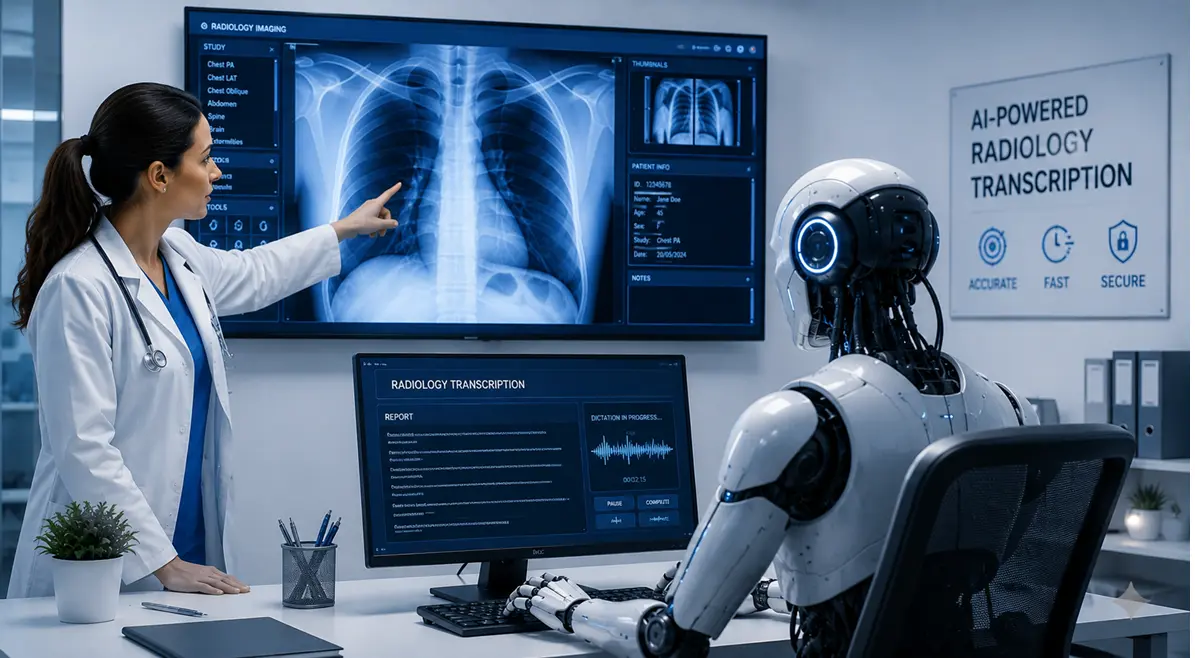
Radiology generates a high volume of clinical information that must be documented accurately and quickly. Radiology Transcription is evolving with artificial intelligence (AI), helping convert physician dictation into clear, organised reports. AI can speed up documentation and reduce repetitive work, but human expertise remains essential for reviewing medical terminology, context, and accuracy.
How AI Is Transforming Radiology Transcription
AI powered speech recognition can convert a radiologist’s dictation into text within seconds. Natural language processing can then identify relevant clinical information and help organise it into a standard report format.
This approach can reduce manual data entry and help radiologists complete reports more efficiently. AI can also support integration with radiology information systems, electronic health records, and other clinical platforms, creating a smoother documentation workflow.
Major Benefits of AI in Radiology Reporting
AI offers several practical benefits for radiology practices, hospitals, and imaging centres.
Faster Documentation
AI can transcribe dictated content almost instantly, reducing the time between examination, dictation, and report completion. Faster reporting can also help referring physicians receive important findings sooner.
Improved Workflow Efficiency
Radiologists can spend less time on repetitive documentation tasks. AI handles initial transcription while professionals focus on reviewing images, interpreting findings, and communicating with care teams.
Consistent Report Structure
AI tools can support standard templates and consistent formatting. This makes reports easier to read and can improve the organisation of clinical information.
Support for High Patient Volumes
Growing imaging volumes can increase documentation demands. AI can help manage routine transcription tasks without adding the same level of manual effort.
Reduced Administrative Burden
Automating repetitive transcription work can reduce administrative pressure on radiologists and staff. This may allow healthcare teams to focus more attention on patient care and other clinical responsibilities.
Challenges Healthcare Providers Need to Consider
AI brings clear advantages, but implementation requires careful planning.
Transcription Accuracy
AI may misunderstand accents, unclear speech, abbreviations, or specialised medical terms. Even a small error can change the meaning of a radiology report. Human review is therefore important before final approval.
Patient Data Security
Radiology reports contain protected health information. AI solutions must have appropriate safeguards for storing, processing, and transferring patient information. Healthcare organisations should also evaluate privacy and security requirements before adopting an AI platform.
System Integration
AI tools need to work effectively with existing PACS, RIS, EHR, and reporting systems. Poor integration can create additional manual work instead of simplifying the workflow.
Human Oversight
AI should support clinical professionals rather than replace their judgement. A qualified reviewer can identify transcription errors, correct terminology, and ensure that the final report accurately reflects the radiologist’s intended meaning.
What Does the Future Hold for AI in Radiology?
AI is moving beyond basic speech to text conversion. Future tools are expected to provide more intelligent support throughout the reporting process.
Generative AI for Report Assistance
Generative AI may help organise clinical information, improve report language, identify inconsistencies, and assist with report summaries. However, these capabilities still require appropriate validation and professional oversight.
Smarter Clinical Workflows
Future AI systems may connect dictation, reporting, imaging, and electronic health records more efficiently. Better interoperability could reduce duplicate data entry and make information easier to access across healthcare systems.
Human and AI Collaboration
The most effective approach is likely to combine AI automation with human expertise. AI can manage routine documentation, while radiologists and trained transcription professionals focus on accuracy, context, quality control, and final review.
Finding the Right Balance Between Technology and Expertise
AI can make radiology documentation faster and more efficient, but speed should never come at the expense of accuracy. Healthcare organisations should consider security, system integration, quality control, workflow compatibility, and human review when evaluating AI solutions.
For many US healthcare providers, combining modern technology with professional Radiology Transcription Services can offer a practical way to improve documentation efficiency while maintaining reliable clinical records.
Frequently Asked Questions
Can AI accurately transcribe radiology reports?
AI can provide fast and useful transcription, but errors may occur with medical terminology, accents, unclear speech, or complex dictation. Professional review helps ensure accuracy.
Will AI replace radiology transcriptionists?
AI can automate routine transcription tasks, but human professionals remain valuable for quality control, context, terminology, and error correction.
How does AI improve radiology reporting?
AI can convert dictation into text quickly, support report formatting, reduce repetitive work, and help streamline the overall documentation process.
Is AI suitable for handling patient information?
It can be used when appropriate privacy, security, compliance, and access controls are in place. Healthcare organisations should carefully evaluate an AI solution before implementation.
What is the future of AI in radiology transcription?
Future developments are likely to include generative AI, smarter reporting assistance, better interoperability, structured documentation, and closer collaboration between AI systems and healthcare professionals.