
Radiology Medical Transcription vs AI Transcription: Key Differences
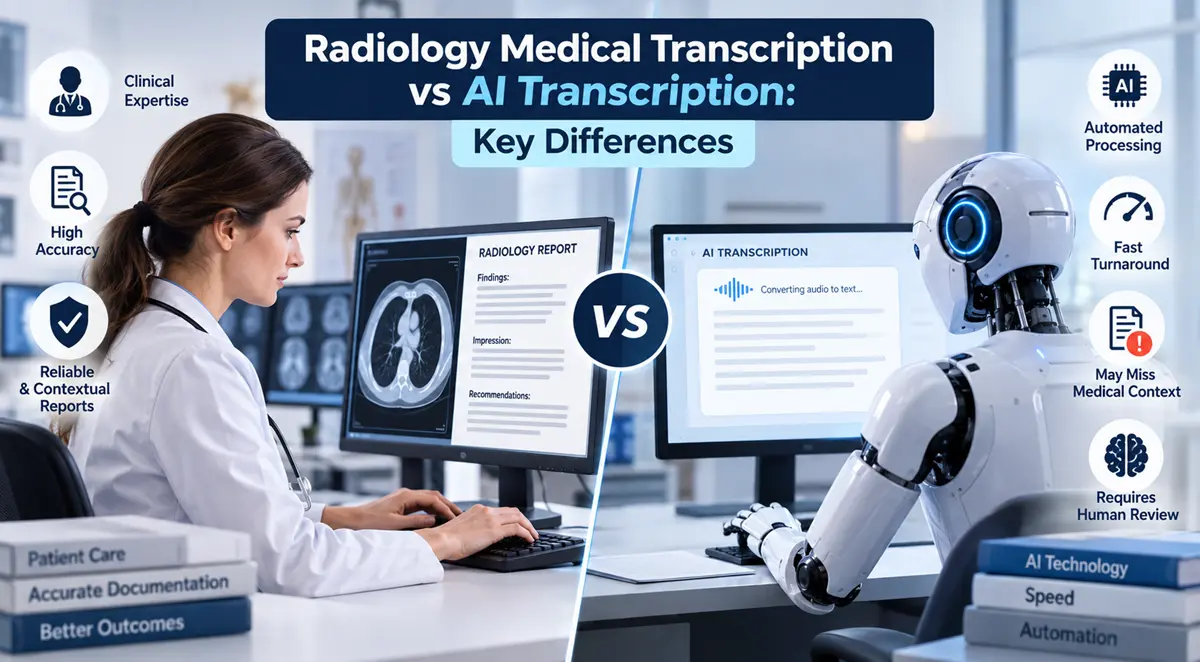
Radiology reporting requires accurate documentation of findings, observations, measurements, and clinical impressions. Medical Transcription has traditionally supported radiologists by converting dictated reports into clear and structured documents. AI transcription now offers automated speech to text and faster processing. Understanding the differences between these approaches can help US healthcare organisations choose a documentation workflow that fits their needs.
What Is Radiology Medical Transcription?
Radiology medical transcription converts a radiologist’s dictated findings into a written report. A trained medical transcriptionist listens to the recording, interprets medical terminology in context, formats the report, and checks the document for errors.
Radiology reports can include complex terms related to CT scans, MRI, ultrasound, X-ray, mammography, nuclear medicine, and other imaging studies. Human review can be particularly useful when dictation includes abbreviations, medication names, anatomical terms, measurements, or similar-sounding words.
The process generally involves:
- Receiving the radiologist’s audio or dictation
- Transcribing the clinical information
- Reviewing terminology and sentence structure
- Following the required report format
- Checking names, measurements, findings, and other details
- Returning the completed report for review and approval
What Is AI Transcription?
AI transcription uses speech recognition and artificial intelligence to convert spoken words into written text. Modern systems can process dictation quickly and may integrate with radiology and electronic health record workflows.
AI can also assist with more than basic transcription. Some newer systems use language models to identify inconsistencies, improve formatting, and flag possible errors for human review. Research published in Radiology found that GPT 4 showed potential for detecting clinically significant errors in radiology reports, although the study evaluated error detection rather than replacing professional reporting or transcription workflows.
Key Differences Between Human and AI Transcription
1. Human Review vs Automated Processing
Traditional transcription includes a trained professional who reviews the dictated content. AI systems primarily depend on automated speech recognition and language processing.
This creates an important difference. AI can produce text rapidly, while human transcription adds a review layer that can identify context related problems that automated systems may miss.
2. Understanding Medical Context
Radiology terminology can be highly specialised. A transcriptionist familiar with radiology can recognise terminology based on the clinical context and report structure.
AI systems are improving in medical language processing, but their performance can vary depending on the speaker, audio quality, terminology, accents, background noise, and complexity of the report.
3. Accuracy and Error Checking
Accuracy is critical because an incorrect word can change the meaning of a radiology report.
A study of 213,977 radiology reports generated using speech recognition found that 9.7% contained errors and 1.9% contained material errors. The researchers also found that error rates varied by radiologist and imaging subspecialty.
Another study comparing breast imaging reports found major errors in 23% of reports created using automatic speech recognition compared with 4% of reports produced through conventional dictation transcription. This was a specific historical study and should not be treated as a current error rate for every AI system.
These findings highlight why quality review remains important regardless of the technology used.
4. Speed and Turnaround Time
AI can convert speech into text within seconds, which can support rapid report creation. This can be useful for high volume radiology departments that need fast documentation.
Human transcription may require more processing time because the report goes through transcription and quality review. However, the additional review can provide an important layer of quality control.
5. Handling Complex Reports
Simple dictation may be relatively easy for an AI system to process. Complex reports can be more challenging because they may contain multiple findings, measurements, comparisons, anatomical references, and specialised terminology.
Human transcriptionists can review the complete dictation and identify inconsistencies that may not be obvious from individual words.
Can AI and Human Transcription Work Together?
Yes. Healthcare organisations do not necessarily need to choose between human transcription and AI.
A hybrid workflow can combine AI for initial speech recognition with professional review for quality control. In this model, AI creates the initial draft while a trained medical transcriptionist reviews and corrects the document before finalisation.
This approach can provide:
- Faster initial document creation
- Professional quality review
- Better handling of complex terminology
- Reduced manual typing
- Support for high report volumes
- A structured quality control process
Research has also shown that generative AI tools may help identify speech recognition errors in radiology reports, suggesting that AI can serve as a supporting quality tool rather than simply a replacement for human review.
HIPAA and Data Security Considerations
US healthcare organisations must also consider privacy and security when selecting any transcription solution. The US Department of Health and Human Services identifies independent medical transcriptionists as examples of business associates when their services involve protected health information. A covered entity generally needs an appropriate business associate agreement when a business associate handles PHI on its behalf.
Healthcare organisations should therefore evaluate:
- HIPAA compliance
- Business Associate Agreement requirements
- Data storage and transmission
- Access controls
- Data retention policies
- Integration security
- Human quality review procedures
- Which Approach Fits Your Radiology Department?
The right choice depends on the organisation’s workflow, report volume, turnaround requirements, technology infrastructure, and quality control needs.
AI transcription may be useful when speed and automation are major priorities. Professional transcription can provide an additional human review layer for complex documentation. A hybrid model can combine automated processing with trained quality review.
For many healthcare organisations, the key question is not simply whether AI or human transcription is better. It is how each technology can be used safely and effectively within the organisation’s radiology reporting workflow.
Frequently Asked Questions
Is AI transcription accurate for radiology reports?
AI transcription can provide fast and useful draft reports, but accuracy varies by system and workflow. Human review can help identify terminology, context, and interpretation related errors.
Is human transcription still useful in radiology?
Yes. Trained transcription professionals can provide quality review and help manage complex medical terminology, formatting requirements, and difficult dictation.
Can AI transcription replace medical transcriptionists?
AI can automate parts of the transcription process, but complete replacement is not appropriate for every workflow. Healthcare organisations should consider the complexity of reports and the need for quality control.
Is AI transcription HIPAA compliant?
HIPAA compliance depends on how the AI service is designed, implemented, and used. Healthcare organisations should evaluate the vendor’s safeguards and applicable business associate requirements before processing PHI.
What are radiology transcription services?
Radiology Transcription Services convert radiologists’ dictated findings into structured written reports. Depending on the provider, the workflow may include professional transcription, AI assisted transcription, quality review, formatting, and delivery through healthcare systems.